
How to Search Criminal Dockets
Start with the court named on whatever paper you have. That paper may be a complaint, a summons, a bail document, or an earlier case notice. For felony records, that court is usually the Butler County Court of Common Pleas General Division. Its official FAQ lists the search routes. They include name, case number, action code, case type, attorney, and date. Electronic files for the Clerk-covered divisions go back to 2000. They are available through Butler Clerk Services eServices.
Misdemeanor, OVI, and domestic-violence matters take a different route. The same goes for preliminary hearings assigned to an Area Court. There, use the court-specific search. Once you have the case number and the newest scheduling entry, the court record gets much easier to read. A web result can point you to the docket. But a filed order or a verified copy must come from the court or clerk that maintains it.
- Read the case paper for the court name and case number.
- Use eServices for Common Pleas work or CaseLook for Area I, II, or III.
- Search with a published category, then open the matching public record.
- Read events by date and use the newest setting-related entry.
- Ask the owning clerk for a copy when a docket entry is not enough.
Butler County Felony Docket Searches
For felony cases, the General Division is the main Butler County criminal docket path. The Butler County Clerk of Courts maintains the General Division record files. EServices is the official entry point for record access. Read the published FAQ before you search. The live service can present a browser-information gate before its form appears. So do not assume anything beyond the court-published categories when you begin. The official eServices access screen is the Common Pleas route to a Butler County criminal docket search.
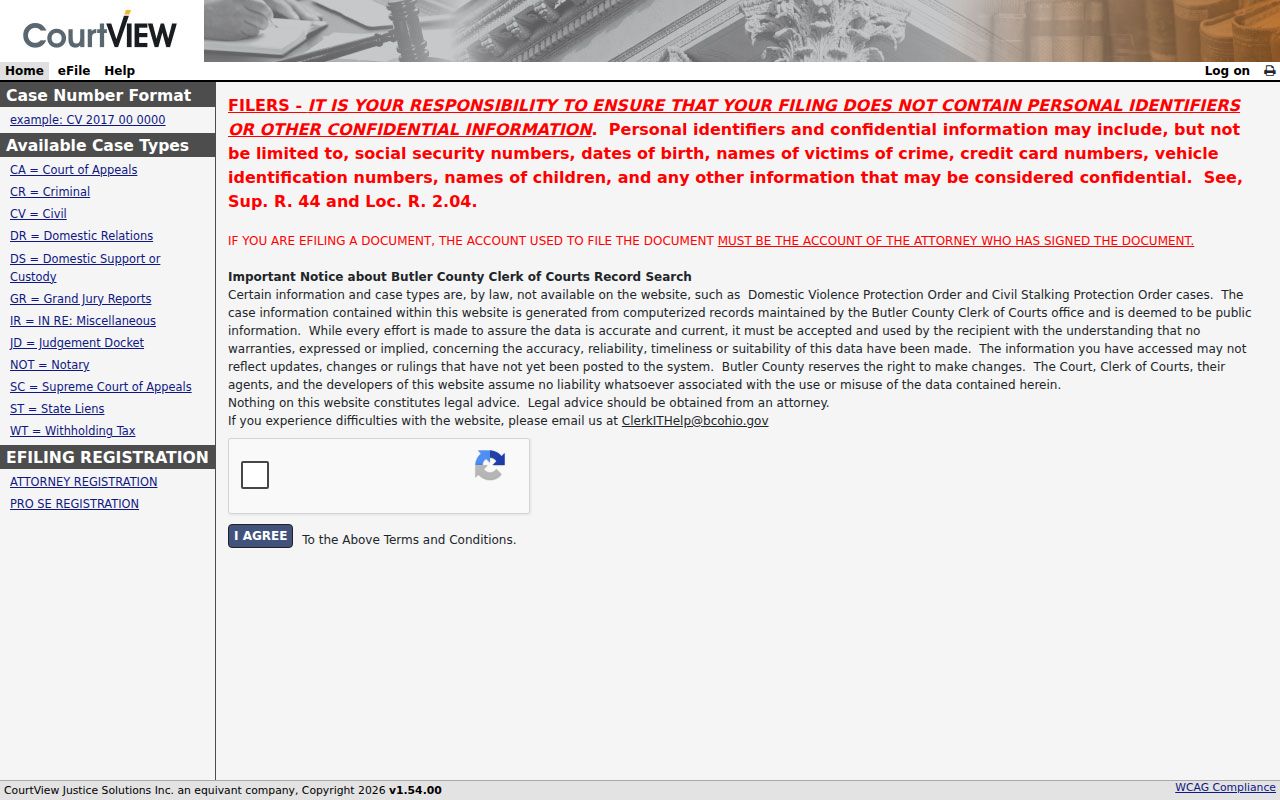
Need verification? Use the returned case number to ask the Butler County Clerk of Courts for a filed image or a certified copy. That request goes through the Clerk, not the search screen.
Butler County Area Court Criminal Paths
Area I, Area II, and Area III Courts are not a junior version of the Common Pleas docket. They handle most of Butler County's misdemeanor, traffic, OVI, domestic-violence, and preliminary-hearing work for their own geographic areas. Their official CaseLook search is a separate county-court record channel. So a failed Common Pleas query settles nothing about whether an Area Court criminal case exists.
CaseLook makes you accept its legal notice before the live search runs. It warns that filing or judicial action can appear on a delay. That delay is at least 24 hours or longer. Anyone who needs verified information should ask the Area Courts directly or visit during regular hours. The official CaseLook notice is a good reminder: a Butler County criminal docket display is not a certified court record.
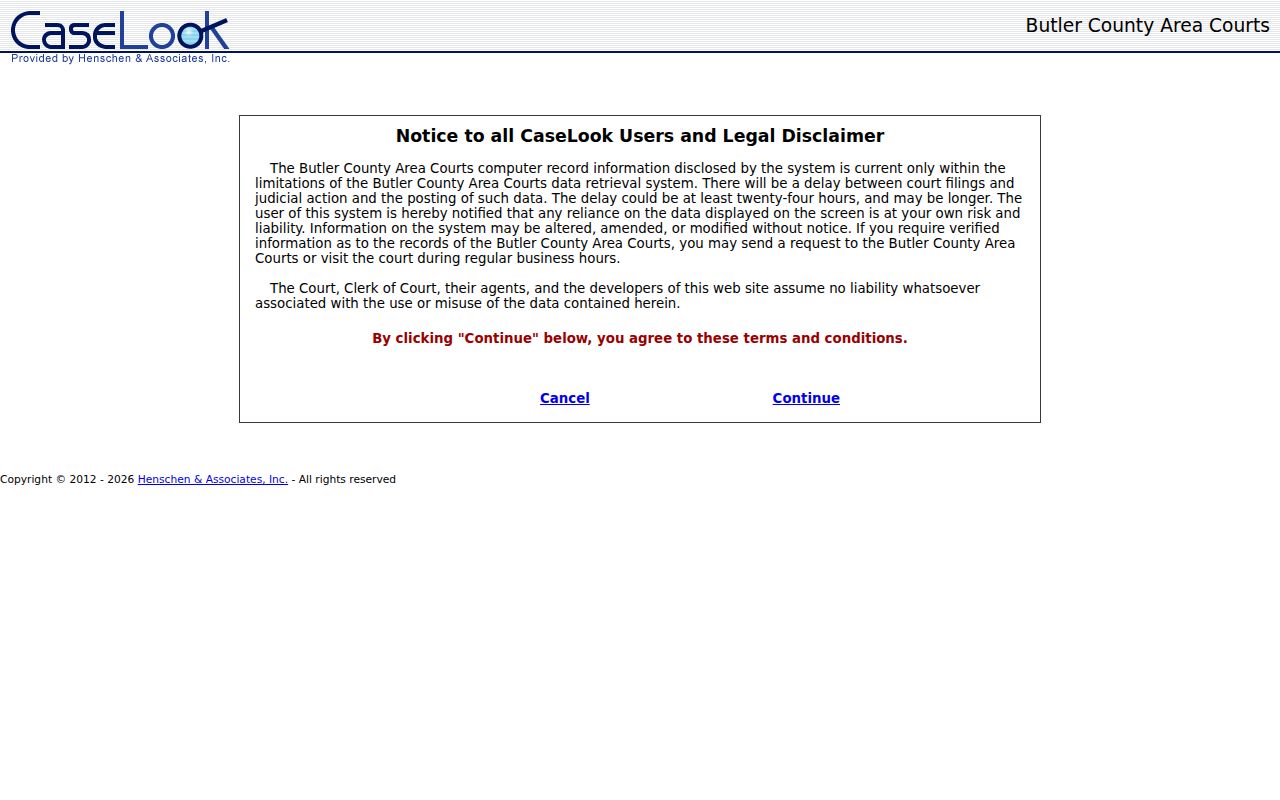
A recent charge or a setting moved the same day should be confirmed with the court that owns the case.
What a Criminal Docket Shows
A public criminal docket is a case record in chronological order, not a full criminal-history product. Local official materials explain its main parts. Those include the case number, the court or Area, the action code or case type, the chronological entries, the date-search route, and public document images where permitted. What a particular screen holds varies. Do not presume charge blocks, bond details, attorney fields, or every possible disposition field from one display.
| Case number | Unique identifier used to find the docket and request a court copy. |
|---|---|
| Court or Area | Shows whether Common Pleas or a named Area Court owns the criminal record. |
| Action code or case type | Published Common Pleas index categories that help narrow a search. |
| Chronological entries | Filing, motion, order, hearing, and other dated case activity where public. |
| Latest setting | The newest public date-related entry is more reliable than an older notice. |
Butler County Area I Criminal Docket
Area I's published Thursday schedule offers a practical map for reading a Butler County criminal docket. Criminal and traffic matters run from 10 a.m. to noon. Review and order-to-appear cases are listed at 11:30 a.m., followed by arraignments, preliminary hearings, bench trials, and reviews. Those labels mark recurring court blocks. They do not tell you the time of a particular defendant's case.
Area I also lists Wednesday criminal and traffic pretrial conferences from 1 p.m. to 1:15 p.m. The docket entry supplies the individual setting. When you check a case's latest entry, treat the standing schedule only as a comparison point.
Stages on a Criminal Docket
A Butler County criminal docket entry can mark each stage of a case, from filing to arraignment, then pretrial work, a plea or trial, disposition, and sentencing where applicable. Area Court schedules expressly list arraignments, preliminary hearings, probation-violation hearings, bench trials, reviews, and other setting types. Each label means something different. Read it with its date and the court named in the record.
Docket flow: Filing → Arraignment → Pretrial → Plea or Trial → Disposition → Sentencing
Butler County Video Initial Appearances
All three Area Courts publish one shared Butler County calendar detail. Video initial appearances happen daily at Area II, Courtroom B, at 345 High Street at 10 a.m. on weekdays. That location can matter even when a case belongs to Area I or Area III. It is a court-wide procedure. It does not prove every criminal case will be heard there.
If a date is urgent, the individual docket and direct court confirmation control. A public schedule cannot show everything. It may miss whether a particular initial appearance was moved, completed, or replaced by another entry.
Which Court Holds Criminal Dockets
Felony charges in Butler County land in the Court of Common Pleas General Division. The Butler County Clerk of Courts holds those dockets. Below that sit the Area Courts. Area I, II, and III each keep their own county-court dockets for the lower-level criminal work assigned to them. Fairfield, Hamilton, and Middletown Municipal Courts run separate municipal records of their own.
Getting the court right matters more than it sounds. That single name tells you who keeps the record, which online docket search to use, which phone to call about a hearing, and which counter can hand you a paper or certified copy. Ohio offers no statewide trial-court portal that merges these Butler County systems. So the court name is your map.
Butler County CaseLook Posting Delay
A blank CaseLook result does not mean the case went away. The Area Courts warn that postings can trail a filing or a judicial action by at least 24 hours. Sometimes the delay runs longer. A search can also miss for a simple reason. The case actually sits in Common Pleas, a municipal court, Juvenile Court, or some other local system with its own docket.
When you need an answer before acting, write down the case number from any public record. Read the newest entry. Then call the court responsible. The Area Courts take counter requests and written requests for verified information. Common Pleas records run through the Clerk's Legal Division.
Butler County Criminal Action Codes
An action code is simply the court's classification for a type of case. It works like an index label. The General Division lists action code among its Butler County search categories outright. Case type appears as a related filter. Both help narrow a wide name search when the case number is unknown. Neither frees you from confirming one thing. The court and case you pulled back must truly be the ones you want.
- Arraignment
- A criminal appearance where a charge is addressed and a plea is ordinarily entered.
- Preliminary hearing
- A lower-court hearing that can appear before a felony proceeds in Common Pleas.
- Fine review
- A named Area III monthly Friday docket session.
Butler County Criminal Setting Changes
A date printed on an older docket entry can move. Area I and Area III will grant a one-week continuance by phone for most misdemeanor and OVI cases, but only on a first request; felony continuances require an appearance before the judge. Area II is stricter still. It continues nothing by phone and warns that a day-before request will not be granted.
Those clashing rules are exactly why the latest Butler County criminal docket entry counts. Read the most recent case activity first. Then call the court that owns the case before you trust any earlier date.
Butler County Docket and Certified Records
A docket display tells you what a case is and the order of its events. That is all it tells you. It is not the clerk's certified proof. Not of a filing, a judgment, or any other disposition.
For a Common Pleas document, contact the Butler County Clerk of Courts with the case number and the exact document name. Say whether you want a plain, certified, or authenticated copy. The Clerk takes requests by mail, email, fax, and in person. Area Court users can ask the particular court for verified information. A visit during regular hours works too. Keeping the request with the custodian who can verify it is the whole point.
Public Access and Sealed Criminal Dockets
Two authorities govern Ohio court records: the Rules of Superintendence and Ohio Revised Code 149.43. Under those rules, the Butler Clerk opens public Legal Division records for review during business hours. It provides copies within a reasonable time. It also redacts protected material. Sealed or expunged criminal matters may simply not show up as public results. Juvenile records sit behind separate confidentiality rules.
Key Rules:
Ohio Sup. R. 44 and 45 define court-record access and require timely access subject to lawful restrictions.
Ohio Revised Code 149.43 provides the general public-record inspection and copy framework.
Ohio Revised Code 2953.32 governs many sealing and expungement proceedings.
The official Area Courts material on sealing covers its own cases and the court process for them. It does not promise that every criminal record can be removed or viewed. For Butler County criminal docket access questions, the Area Courts sealing and expungement information lays out the local application route.
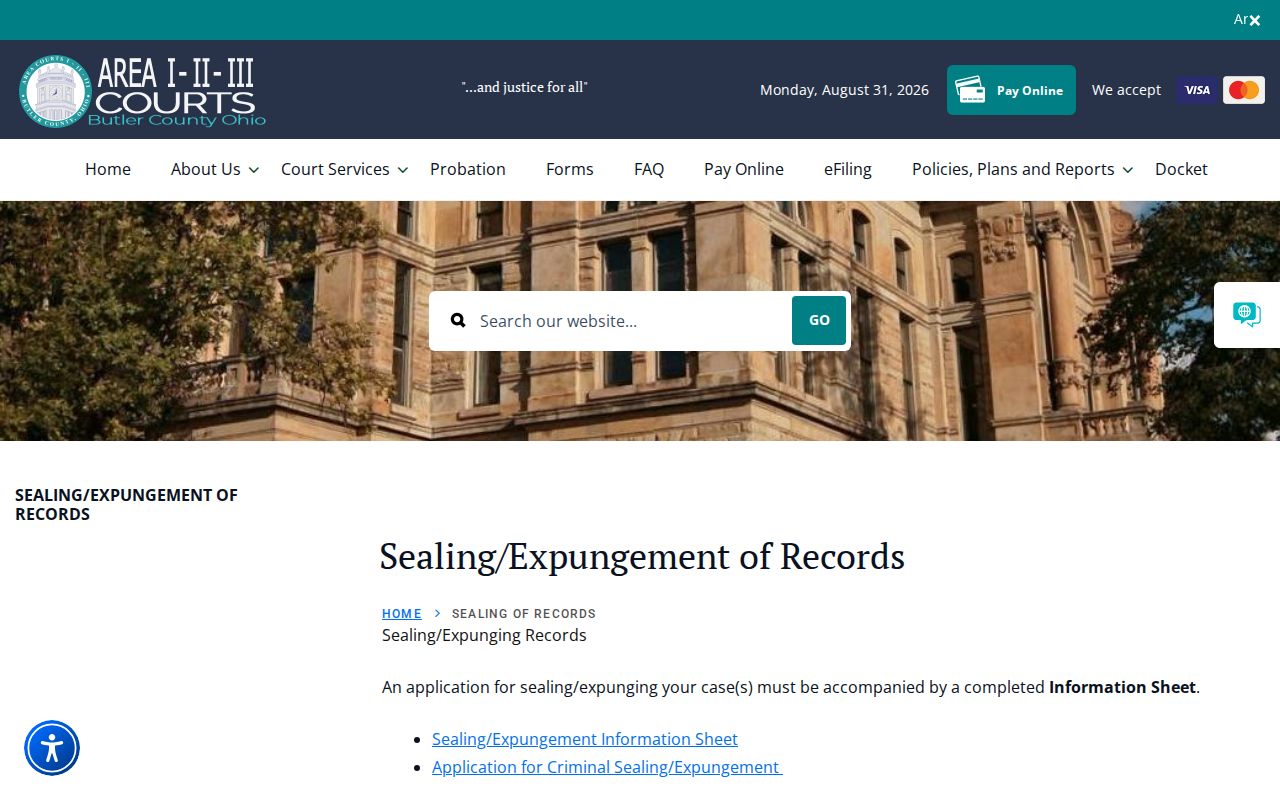
For any restricted record, the sentencing court is where to turn. That court can explain the governing process and where public access stops.